 Life Insurance: Understanding the Protection You May Need and How to Evaluate It
  How Advanced Servers Are Supporting the Expansion of AI
  The Role of Research, Data, and Insight in Modern PR Campaigns
  Practical Financial Management Strategies for Salaried Professionals and Businesses
  How Household Replacement Cycles Influence When to Use Fridge or Mobile EMI
  Mapping Success: How to Choose the Best Location for a Dispensary
  Diversified Investment Pathways: A Formal Look at the Integration of NSE IPO and SIP
  Open Your Demat Account Today to Invest in NSDL and Track Its Share Price
  Documentation and Verification in Digital Gold Loan Applications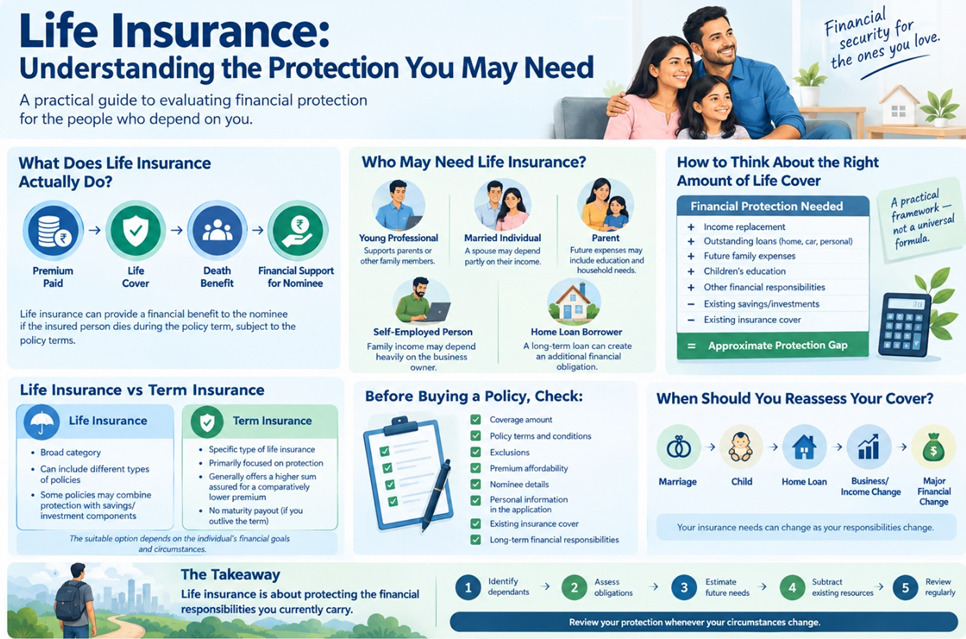
Most people don’t think about life insurance until something forces them to. A colleague mentions it after a health scare in the family. A friend brings it up while paying off a home loan. Or someone simply sits down one evening, looks at their monthly expenses, and realises that a fair share of it depends entirely on their own paycheque continuing to arrive. That’s usually when the question comes up: what happens to the people who depend on that income if it suddenly stops?
This is really what general life insurance is meant to address. Not as a financial product to tick off a list, but as a way of making sure the responsibilities you currently carry don’t collapse in your absence.
What Life Insurance Actually Does?
At its core, a life insurance policy is an agreement. The policyholder pays a premium, either monthly, annually, or as a lump sum, and in exchange, the insurer promises to pay a sum of money — the death benefit — to a chosen nominee if the policyholder passes away during the policy term.
Think of it less as an investment and more as income replacement. If a person earning a steady salary were to die unexpectedly, the household would lose that income overnight. The payout from a life cover is meant to fill that gap, at least for a while, so that rent, school fees, loan repayments, and daily expenses don’t suddenly become unmanageable for the family left behind.
Who Should Think About Life Insurance?
There isn’t a single profile of a person who needs cover. A young professional who sends money home to support ageing parents has a reason to think about it. So does a married individual whose spouse depends partly on their income. Parents with young children, obviously, have a longer list of future expenses to account for.
Even a self-employed person, whose family relies entirely on the income from a business they run, has a strong case for cover —arguably more so, since there’s no employer-provided safety net involved. Someone who has recently taken a home loan may also want to reconsider their protection, simply because the liability now sits on their shoulders for the next several years.
How Much Life Cover Is Enough?
There’s no universal formula that works for everyone, despite what many quick calculators suggest. A more useful approach is to look at your own numbers. Start with your current income and how many years it would realistically need to be replaced. Add any outstanding loans For home, car, personal. Factor in the number of dependants and what their future expenses might look like, including children’s education. Then subtract what you already have in savings, investments, or existing insurance.
What remains gives a rough sense of the protection gap in the difference between what your family would need and what’s already covered.
Life Insurance and Term Insurance: Are They the Same?
Not quite. Life insurance is the broader category. Term insurance is a specific, simpler type within it is pure protection, with no maturity payout if the policyholder outlives the term. It tends to offer a higher sum assured for a comparatively lower premium, which is why many people evaluate it early. Other types of life insurance combine protection with savings or investment components, usually at a higher cost. Neither is inherently better; it depends on what the person is trying to achieve.
What People Often Overlook Before Buying a Policy?
A common mistake is comparing policies purely on premium, without checking what’s actually covered. Some buyers choose an amount of cover based on what feels affordable today, rather than what their family would genuinely need. Policy exclusions often go unread until a claim is being processed — by which time it’s too late to do anything about it. Small errors, like an outdated nominee detail or incorrect personal information at the time of purchase, can also cause complications later.
Life Changes, So Insurance Needs Can Change Too
The cover that made sense five years ago may not make sense today. Marriage adds a dependant. A child adds a much longer financial horizon. A home loan adds a fixed, long-term liability. Starting a business might change both income and risk. None of these events require buying a new policy immediately, but they’re reasonable moments to sit down and reassess whether existing cover still fits.
A Practical Way to Think About Life Insurance
A simpler way to approach the decision:
Identify who currently depends on your income.
List your major financial obligations.
Estimate future responsibilities, not just current ones.
See what you’ve already got in savings, other policies and subtract that.
Decide what level of protection is realistically affordable.
Revisit the decision whenever your circumstances change.
None of these steps require expert knowledge — just an honest look at your own finances.
Life insurance, in the end, isn’t really about the policy document or the premium receipt. It’s about making sure that the people who depend on you aren’t left to manage financial responsibilities they didn’t create and may not be equipped to handle alone. That’s a decision worth making with a clear head, not under pressure — and it’s one worth revisiting as life itself keeps changing.